Find out how easy it is to capture and share pixel-perfect screenshots at scale using Allscreenshots. Sign up for a free account and start integrating your first screenshot API call today.
RT
Riley Thompson
Developer advocate focused on web tooling, screenshot APIs, and helping teams ship better visual experiences.
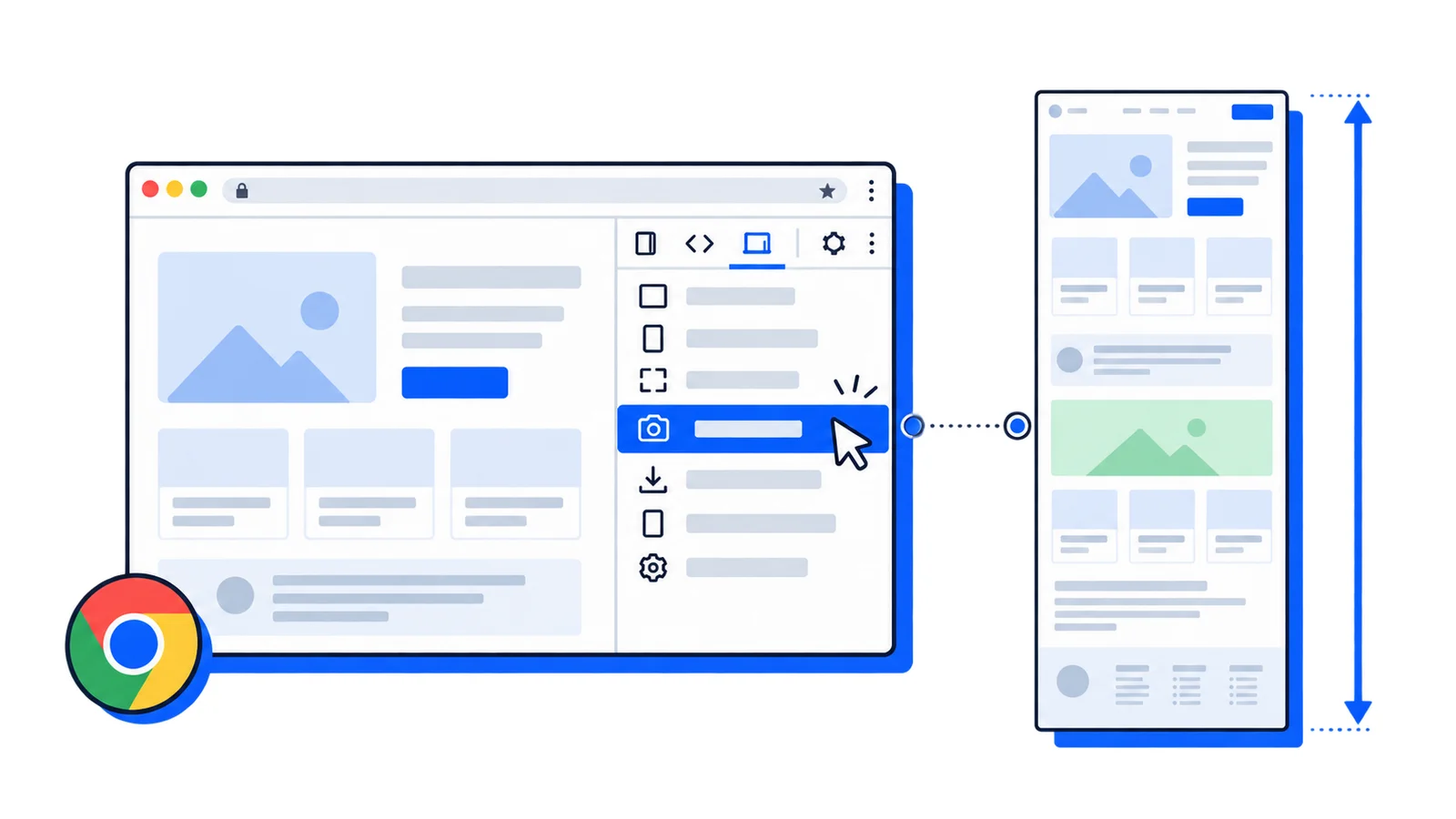
Chrome can make a full page screenshot without an extension. The feature is built into DevTools, but it is hidden behind the command menu, so it is easy to miss if you only use the normal browser toolbar.
This guide shows the built-in Chrome method, what to do when it fails on long or dynamic pages, and when it makes sense to use AllScreenshots screenshot automation instead of taking screenshots by hand.
Quick Answer
To take a full-page screenshot in Chrome:
Open the page in Chrome
Press Ctrl+Shift+I on Windows or Linux, or Cmd+Option+I on macOS
Press Ctrl+Shift+P on Windows or Linux, or Cmd+Shift+P on macOS
Type screenshot
Select Capture full size screenshot
Chrome saves a PNG file to your Downloads folder. The image contains the full scrollable page, not just the part currently visible on screen.
If images are missing, scroll to the bottom of the page once, wait for lazy-loaded content to appear, then run Capture full size screenshot again.
Chrome Full Page Screenshot Shortcut
There is no single Chrome shortcut that immediately captures the full page. The shortcut opens the DevTools command menu, then you choose the screenshot command.
Platform
Open DevTools
Open command menu
Command to choose
Windows
Ctrl+Shift+I
Ctrl+Shift+P
Capture full size screenshot
Linux
Ctrl+Shift+I
Ctrl+Shift+P
Capture full size screenshot
macOS
Cmd+Option+I
Cmd+Shift+P
Capture full size screenshot
If DevTools is already open, you can skip the first shortcut and go straight to the command menu.
Step-by-Step: Make a Full Page Screenshot in Chrome
1. Open the page you want to capture
Load the URL in Chrome and wait until the page appears stable. If the page uses animations, dashboards, charts, or lazy-loaded images, give it a few extra seconds before opening DevTools.
2. Open Chrome DevTools
Use Ctrl+Shift+I on Windows or Linux, or Cmd+Option+I on macOS. DevTools can be docked to the side, bottom, or a separate window. The docking position does not matter for the screenshot.
3. Open the command menu
Use Ctrl+Shift+P on Windows or Linux, or Cmd+Shift+P on macOS. This opens the same kind of command palette you may know from VS Code.
4. Search for screenshot
Type screenshot. Chrome will show several screenshot commands.
5. Choose Capture full size screenshot
Select Capture full size screenshot. Chrome renders the full scrollable document and downloads a PNG.
Chrome Screenshot Commands Explained
Chrome DevTools includes more than one screenshot command. Choose the one that matches the job.
Chrome command
Captures
Use it for
Capture full size screenshot
The whole scrollable document
Full page screenshots, landing pages, articles, docs
Capture screenshot
The current viewport only
Above-the-fold checks and quick bug reports
Capture area screenshot
A rectangle you draw
Cropping a specific visible section
Capture node screenshot
The selected DOM element
Components, pricing cards, modals, headers
For most "Chrome full page screenshot" searches, Capture full size screenshot is the right choice.
If you only care about the first viewport, try the free above-the-fold checker. It is more useful than a raw Chrome viewport screenshot when you need to inspect what appears before a user scrolls.
How to Make a Mobile Full Page Screenshot in Chrome
Chrome can also capture a mobile-sized full page screenshot:
Open DevTools
Click the device toolbar icon, or press Ctrl+Shift+M / Cmd+Shift+M
Choose a device preset or enter a custom width and height
Refresh the page so responsive layout and scripts load for that viewport
Open the command menu
Choose Capture full size screenshot
This is useful for checking responsive layouts, but it is still a manual workflow. If you need desktop, tablet, mobile, light mode, and dark mode screenshots repeatedly, use AllScreenshots screenshot automation or the visual regression testing workflow so each viewport is captured consistently.
Why Chrome Full Page Screenshots Break
Chrome's built-in screenshot feature is convenient, but it captures what Chrome can render at that moment. Modern websites often make that harder than it sounds.
Lazy-loaded images are missing
Many pages do not load below-the-fold images until the user scrolls. Chrome's full page capture may finish before those images are requested.
Fix it manually by scrolling through the page before capturing. For automated captures, AllScreenshots' full-page screenshot capture uses smart scrolling to load lazy content before the final image is created.
Cookie banners and ads cover the page
Consent banners, chat widgets, newsletter popups, and ads are part of the rendered page. Chrome does not remove them before taking the screenshot.
For clean output, close overlays manually before capture. If you need repeatable captures, AllScreenshots blocks ads and cookie banners by default for new captures, as described in ad and cookie blocking now default.
Sticky headers repeat or hide content
Fixed headers, sticky footers, and floating toolbars can cover content while Chrome stitches the full page image. This is especially common on marketing pages and ecommerce sites.
When the screenshot is evidence or documentation, review the output carefully. For compliance use cases, pair full-page capture with scheduled records through compliance and auditing screenshots.
Very long pages can be clipped
Extremely tall pages can produce very large PNG files. Chrome may clip content, create blank regions, or download a file that is awkward to preview and share.
If the page is very long, capture meaningful sections separately or use a screenshot service that handles the scrolling and rendering pipeline for you.
Web apps may use internal scroll containers
Apps like dashboards, editors, inboxes, project tools, and analytics pages often scroll inside a panel instead of the whole document. Chrome's full size screenshot captures the document, not every nested scroll container.
For those cases, use Capture node screenshot on the specific panel, or automate a purpose-built workflow with custom selectors.
How to Capture a Specific Element
Element screenshots are useful when you do not want the entire page.
Open DevTools
Click the element picker icon in the top-left of DevTools
Click the element you want to capture
Open the command menu with Ctrl+Shift+P or Cmd+Shift+P
Type screenshot
Choose Capture node screenshot
Chrome saves only the selected element. This works well for documentation, QA reports, design reviews, and bug tickets where a full page screenshot would include too much noise.
Chrome DevTools vs Extensions vs AllScreenshots
The best method depends on how often you take screenshots and what you need to do with the result.
Method
Best for
Limitations
Chrome DevTools
Occasional full page screenshots
Manual, hidden UI, inconsistent on complex pages
Chrome extensions
Frequent manual capture and annotation
Requires installation, often browser-specific
Puppeteer or Playwright
Developer scripts and tests
You manage Chrome, dependencies, memory, retries, and hosting
Use AllScreenshots when you need the same capture to work again tomorrow, from CI, on a schedule, across many URLs, or with clean defaults for ads and cookie banners.
Make a Chrome Full Page Screenshot from Code
If you want to automate Chrome yourself, Puppeteer can create a full page screenshot:
This works well for local scripts and controlled pages. In production, you also need to manage Chrome versions, Linux dependencies, timeouts, crashes, resource limits, retries, proxy behavior, and storage.
Can Chrome make a full page screenshot without an extension?
Yes. Open DevTools, open the command menu, type screenshot, and choose Capture full size screenshot.
Where does Chrome save full page screenshots?
Chrome usually saves DevTools screenshots to your Downloads folder. If your browser or operating system asks where to save downloads, choose the folder when prompted.
Why is my Chrome full page screenshot blank or cut off?
The page may be too tall, too dynamic, or using rendering patterns that Chrome's DevTools screenshot command does not handle well. Try scrolling through the page first, closing overlays, reducing the viewport height, or capturing sections separately.
Can Chrome make a full page screenshot on mobile?
Chrome desktop can emulate a mobile viewport in DevTools and then capture a full size screenshot. Open the device toolbar, choose a mobile preset, refresh the page, then run Capture full size screenshot.
Is a Chrome full page screenshot the same as printing to PDF?
No. A screenshot captures the screen rendering as an image. A PDF uses print rendering, pagination, and print CSS. Use HTML to PDF when you need a document, and use screenshots when you need an image of the rendered page.
What is the best way to automate Chrome full page screenshots?
For local scripts, Puppeteer or Playwright works. For production workflows, scheduled captures, CI/CD, batches, clean output, and retries, use AllScreenshots screenshot automation.